
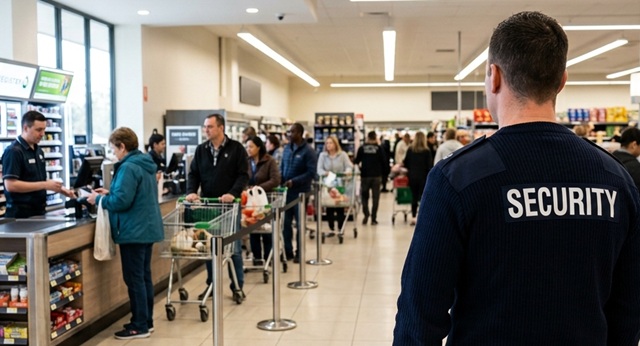
Retail Security in Copenhagen, Denmark
Our security company provides guards for the retail sector in Copenhagen. We protect the retail sector's assets, operations, staff and customers around the clock in Copenhagen and the rest of Denmark.
We provide on-site guarding of retail stores both during and outside opening hours. Whether your store is operating as usual, undergoing remodeling or restoring security after a break-in or robbery, we deploy uniformed security guards to handle these situations, ensuring a visible and professional security presence that deters crime and reassures employees and shoppers alike.
Inside the store, our uniformed security guards carry out regular security rounds to prevent shrink, shoplifting, and disturbances, and can be posted directly at the checkout area where theft and conflicts most often occur. When incidents do happen, our security personnel are educated and trained in conflict resolution techniques, the detention of shoplifters, preventing robberies and disturbances, as well as intervening to protect staff and business assets and summoning the police and fire services when situations require it.
Beyond daily operations, we also specialize in crowd control for high-traffic occasions such as store openings, sales events, and Black Friday where large crowds require careful management to ensure both safety and a positive shopping experience.
With our retail security services, you get a professional security partner who protects your bottom line, reduces losses and creates a safe and secure environment for your customers and employees.
Retail Security Services
- Retail security.
- On-site guarding of retail stores during and outside opening hours.
- On-site guarding of retail stores undergoing remodeling.
- On-site guard services in stores following break-ins or robberies.
- Fire watch guards during technical breakdowns, system maintenance or hot work.
- Security rounds in stores to prevent shrink, shoplifting, and disturbances.
- Uniformed security guard posted at the checkout.
- Crowd control during store openings, sales events, Black Friday, and similar occasions.
- Handling of shoplifting incidents, including detaining shoplifters until the police arrive.
- Security guarding of retail premises outside opening hours during installation work or visits by craftsmen.
Coverage area: We cover the whole of Denmark.
Selected References


Yes, we provide professional security guards for the retail sector throughout Copenhagen and surrounding areas. Our security personnel are trained and authority-approved, ensuring a secure shopping environment for staff and customers in stores, shopping malls and department stores throughout Denmark.
Contact our customer service, open day and night, by phone at (+45) 2420 1101; we speak both Danish and English. Email our sales department at: web@dansk-sikkerhedsvagt.dk
Yes, we deliver professional store security with retail guards and fire watch across all regions of Denmark. Whether you operate a single boutique or manage a nationwide retail chain, we provide customized security coverage adapted to your specific business requirements.
Our customer service is available around the clock – call us day and night at (+45) 2420 1101. We speak both Danish and English, or reach our sales department by email at web@dansk-sikkerhedsvagt.dk
Yes, we provide loss prevention services to retail businesses in Copenhagen and the surrounding area. We offer both uniformed security guards and plainclothes store detectives, as well as exit control at closing time (staff bag checks). Our visible security guards not only create a safe shopping environment for retail stores – we also help reduce losses, shrinkage, theft and attempted robberies.
Do you have questions? Our English- and Danish-speaking customer service team is ready to help you 24/7 at (+45) 2420 1101. You can also email our sales department at: web@dansk-sikkerhedsvagt.dk
Yes, we implement targeted theft prevention solutions for retail establishments in Copenhagen. Through a visible security presence on the sales floor, discreet observation and proactive deterrence, our guards effectively prevent shoplifting while maintaining a professional and welcoming atmosphere.
Get in touch whenever it suits you – our customer service answers your call day and night at (+45) 2420 1101, in both Danish and English. Prefer email? Write to our sales department at: web@dansk-sikkerhedsvagt.dk
Yes, we provide fire watch guards for retail stores in Copenhagen whenever fire protection systems fail or are taken out for maintenance. Our fire watch guards are available 24/7 to ensure continuous coverage, both during and outside your opening hours, as needed — helping you stay compliant and keep your store open.
Contact our 24/7 customer service by phone at (+45) 2420 1101; we speak both Danish and English. Or email our sales department at web@dansk-sikkerhedsvagt.dk
Preventing shoplifting requires a proactive, layered approach combining active deterrence, staff awareness, and clear visibility. Key actions include greeting every customer immediately upon entry, maintaining open sightlines without blind spots, securing high-value items, and deploying visible, uniformed security personnel to deter potential offenders.
Beyond these core measures, retailers can further reduce shoplifting by combining the following practices:
- Staff training: Teach employees to recognise warning signs such as nervous behaviour, loitering, oversized clothing or bags, and groups that try to distract staff. One typical sign is a customer who takes off their backpack, opens it at the top, and places it between their legs while standing at a shelf, as this makes it easy to slip items into the bag unnoticed. Staff should respond calmly and without confrontation, for example by offering help and making their presence known, which often deters the attempt on its own.
- Visible CCTV and signage: Clearly displayed cameras and signs act as a deterrent, especially near entrances, exits, and high-risk areas.
- Electronic article surveillance (EAS): Security tags, detection gates, and door alarms make it harder to leave the store with unpaid items.
- Smart store layout: Use low shelving, convex mirrors, good lighting, and place the checkout near the entrance so staff can monitor customer flow.
- Product display and protection: Keep small, expensive, or frequently stolen goods in locked cabinets or behind the counter, and avoid overstocking shelves in hidden corners.
- Fitting room control: Limit the number of items allowed per visit, count items going in and out, and keep the area supervised.
- Adequate staffing at peak times: Make sure the sales floor is never left unattended during busy periods or shift changes.
- Regular stock checks: Frequent inventory counts help identify loss patterns early, so you can adjust measures where they are needed most.
- Clear incident procedures: Define how staff should report, document, and handle suspected theft, including when to involve security personnel or the police.
Retail shrink is the total loss of inventory between delivery from the manufacturer and the point of sale, caused by shoplifting, employee theft, administrative errors and vendor fraud.
Shrink can be reduced in several ways:
- Stay alert to the behaviour of both customers and employees.
- Check incoming deliveries against supplier invoices, so you do not pay for goods that were never delivered.
- Install cameras in the sales area and in storage areas.
- Lock the doors to back rooms and storerooms behind the sales area.
- Occasionally check staff bags when employees finish their shifts and leave the workplace.
- Report shoplifting incidents to the police, so word gets around that the store does not tolerate theft.
- Station security guards at the exit and by the security tag detection gates.
- Install a security tag detection system at the entrance to the customer toilets.
- Supervise the fitting rooms.
The difference lies in who commits the theft. Internal theft is carried out by people who work in or for the business, while external theft is carried out by people from outside the organisation.
Internal theft is committed by employees, and sometimes by contractors or temporary staff. Common methods include manipulating the till, such as voiding sales or issuing false refunds, giving unauthorised discounts to friends or family, and taking stock from backrooms, storerooms, or the delivery area. Because employees know the store's routines, systems, and blind spots, this type of theft can continue unnoticed for a long time and often causes greater financial losses than shoplifting.
External theft is committed by people with no connection to the business. It includes opportunistic shoplifting by individual customers, as well as organised retail crime, where groups steal goods in large quantities to resell them. It can also include break-ins and burglary outside opening hours.
Effective prevention requires measures against both types of theft. Internal theft is best reduced through clear access controls, separation of duties, regular till and stock audits, and consistent procedures for deliveries and returns. External theft is best reduced through visible physical security, good store layout, camera surveillance, and active supervision of the sales floor by trained staff or uniformed security personnel.
The most effective loss prevention strategies combine accurate stock control, secure physical protection of goods, and active surveillance. No single measure is enough on its own, because losses can occur at several points: on the sales floor, at the till, in the stockroom, and during deliveries.
Stock control and data. Continuous cycle counting, where small sections of the inventory are counted regularly instead of once a year, helps you detect discrepancies early. Point-of-sale exception reporting highlights unusual transactions, such as frequent voids, repeated refunds, or heavy discounting, so you can investigate them quickly.
Merchandise protection. RFID and electronic article surveillance (EAS) tags make it harder to remove goods from the store unnoticed and trigger an alarm if unpaid items pass the exit. Restricted access controls for stockrooms, such as locked doors, key or card registration, and limited authorisation, reduce the risk of internal theft and unexplained stock loss.
Surveillance and deterrence. Visible uniformed security guards deter potential offenders and can respond immediately to suspicious behaviour. When guards work together with real-time video surveillance, incidents can be detected, documented, and handled before the merchandise leaves the store.
To get the best results, these measures should be reviewed regularly and adjusted based on where your data shows that losses actually occur.
Securing a modern retail store requires a multi-layered approach that integrates physical security, technology, professional security personnel, and clear operational routines.
Effective loss prevention strategies include:
- High-definition CCTV surveillance covering sales floors, checkout points, register areas and stockrooms behind the retail floor.
- An optimized store layout with open sightlines and minimal blind spots to deter shoplifting.
- Electronic Article Surveillance (EAS) tags on merchandise combined with security detection gates at exits.
- An access control system for the stockroom to restrict unauthorized entry.
- Integrated burglar alarms on doors, windows, and perimeter room sensors.
- Strict verification procedures at goods receiving to ensure supplier invoices match actual deliveries.
- Professional security guards during trading hours to maintain visible deterrence in high-traffic or high-risk locations.
- Designated staff entrances and exits separate from primary customer access points.
- Standardized procedures for cash handling, till reconciliation, and customer returns.
- Clear protocols for recording personal items brought into and taken out of the store by employees.
- Routine bag and personal belonging checks for staff at the end of shifts.